

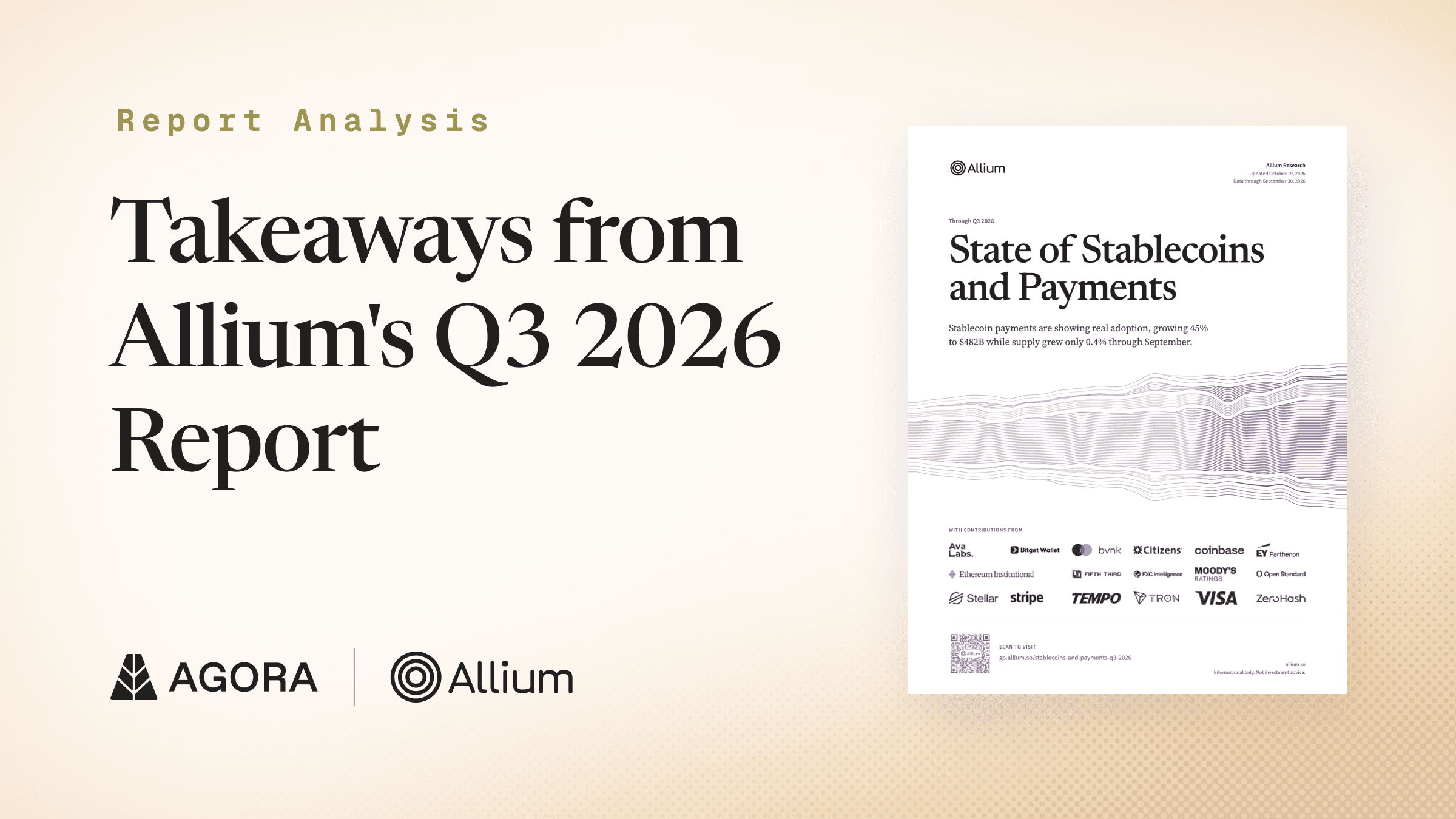
Last week, Allium Research published its State of Stablecoins and Payments report for Q3 2026, with contributions from 18 industry leaders, industry insiders, and professionals. One pair of numbers jumped out at us. Through September, total supply grew just 0.4% to $305B. Stablecoin payments grew 45% to $482B.
Supply barely moved, but usage kept climbing. Stablecoins aren’t growing by putting more dollars onchain anymore. They’re growing because more people and businesses are using them, more often, on more networks. Here’s what we took away:
Five takeaways from the report
1. Growth has moved beyond the largest issuers
In 2025, Tether, Circle, and Ethena drove most of the market's expansion. This year, all three shrank, while other issuers added a net $6.9B. The number of issuers with more than $1B outstanding rose from 11 to 15. The top of the market is flat. The growth is happening one tier down.
2. Distribution is the new competitive frontier
This is the report’s biggest theme, and the one we think about most. Issuing a stablecoin is becoming table stakes. Getting it into the products people already use is where issuers now compete. The report highlights new models built around partners, including Open USD, which shares reserve economics with the companies that bring it supply, and branded stablecoins like Polymarket's pUSD that are backed by an existing issuer's coin. These models are still early, and Allium points out that their staying power depends on whether the economics work for both sides.
3. Usage is growing faster than supply
Allium filters $97.9T in raw transfers down to $2.4T of adjusted volume, its measure of real end-user activity. That figure rose 48%, while payment count rose 71%. Activity is also spreading across networks: Solana, Polygon, Plasma and HyperEVM more than doubled, though Tron still carries about two-thirds of volume. And moving money keeps getting cheaper. By September, average fees on most major chains were under a cent.
4. Businesses carry most of the value
Consumers send most of the payments, but businesses move most of the money. Through September, the average business-to-business payment was larger than it was a year earlier, while the average consumer-to-business payment got smaller. Payroll and supplier payments are now meaningful categories, and payments involving businesses also had a higher cross-border share than consumer transfers.
5. New rails are emerging, at very different speeds
Stablecoin card spend grew 10x to $3.9B, letting holders spend at ordinary merchants that never touch a stablecoin. AI agent payments doubled to 68.3M transactions in Q3, but their total value was just $3.7M. Agents are clearly experimenting with stablecoins but spending has not accelerated yet.
Our take: the infrastructure layer matters more than ever
The report confirms something we hear from enterprises and fintechs every day: the question is no longer whether to use stablecoins, but how to bring them to customers through the products those customers already use.
That shift puts the focus on infrastructure. Allium's market map groups a small set of companies, Agora among them, as the stablecoin infrastructure that other businesses build on. As distribution becomes the competitive frontier, the businesses doing the distributing will look closely at who sits underneath them including how the stablecoin is issued, how reserves are managed and reported, and whether the issuer's incentives are aligned with theirs or competing against them.
A few other signals point the same way. Institutions held $82B in stablecoin wallet balances, more than consumers and businesses combined. Business payments are growing in size. And the report's contributors from Visa, Fifth Third, Citizens and others repeatedly stress fitting stablecoins into existing treasury, payment and compliance workflows. That is the work Agora is built for.
Read the full report
This is only a slice of Allium's analysis. The full report covers supply by issuer and network, how Allium separates real payments from raw transfer volume, payment purposes and corridors, the new payment chains, and a detailed ecosystem market map.
Download State of Stablecoins and Payments, Q3 2026 from Allium
Data is from Allium Research’s State of Stablecoins and Payments, Q3 2026 (updated October 19, 2026; data through September 30, 2026). Allium’s figures are its own estimates, not verified by Agora. Commentary reflects Agora’s views, not those of Allium or the report’s contributors, and references to third parties do not imply endorsement. For informational purposes only; not investment, or an offer or solicitation regarding any digital asset, including AUSD.